

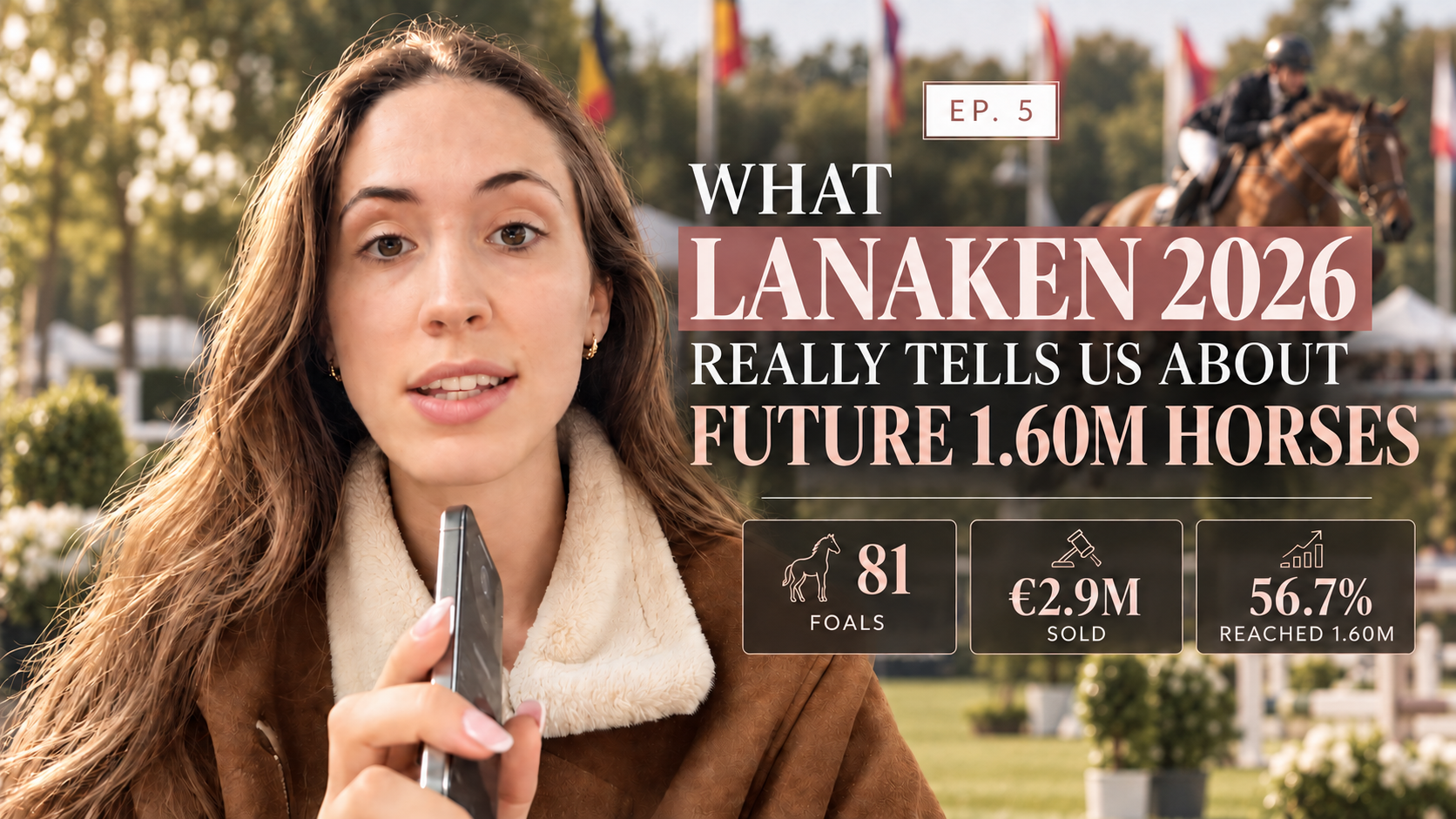
Lanaken is one of the few places where you can see almost the entire sport horse market in one place.
You have some of the best five, six and seven-year-old horses in the world competing.
You have breeders, riders, owners and buyers from across the industry.
And alongside the championships, you have foals selling for tens, and sometimes hundreds, of thousands of euros.
That makes Lanaken more than a championship.
It is a snapshot of what the market values today and what it believes will matter tomorrow.
We looked at the 2026 results, foal prices and historical championship data to answer one central question:
What can Lanaken actually tell us about the horses most likely to reach the top of the sport?
€2.9 Million Worth of Foals
Across the Friday and Saturday foal sales analysed, 81 foals had published selling prices.
Together, they represented more than:
€2.9 million in sales
The average price was approximately:
€35,900
But the median was lower:
€30,000
That distinction matters.
One foal sold for €150,000, which pushes the average upwards.
Remove that single transaction and the average drops closer to €34,500.
So if you want to understand what a strong commercial foal was actually trading for at Lanaken this year, the €30,000 median probably tells us more than the headline average.
But the most interesting question is not what the average foal cost.
It is why some foals sold for two, three or five times more than others.
What Were Buyers Actually Paying For?
The most expensive foal in the dataset sold for:
€150,000
It would be easy to explain that price through the sire.
But the strongest-priced foals repeatedly showed another pattern.
Proven sport very close to the female family.
The €150,000 foal came directly from a mare that had competed at 1.60m.
Another foal sold for approximately €82,000 with a 1.60m dam.
Another reached approximately €64,000 from a 1.65m mare.
Another sold for around €60,000 with an exceptionally strong direct maternal connection to proven top-level sport.
That repetition matters.
At the premium end of the foal market, buyers appear to be paying not only for fashionable genetics, but for evidence.
When You Buy a Foal, You Are Buying Probability
A foal has done almost nothing.
You do not yet know if it will be:
- brave
- careful
- scopey
- rideable
- sound enough for elite sport
- mentally strong
- properly produced
So what are you actually buying?
Probability.
And the closer that foal is to proven high-level horses, the more evidence you have to support that probability.
This is where the female family becomes extremely important.
A strong stallion may attract attention.
But a proven mother or grandmother can significantly strengthen the case for the horse.
A simple way of putting it is:
The stallion gets people to open the catalogue.
The mother gets people to raise their hand.
Do Not Read a Pedigree Only From the Top
One of the biggest mistakes in breeding analysis is looking only at the sire.
A fashionable stallion does not automatically create an expensive or exceptional foal.
Instead, buyers should look deeper.
Ask:
- What did the dam achieve?
- What has she already produced?
- What did the grandmother produce?
- How many international horses are close in the family?
- How close is this foal to proven 1.50m, 1.60m or 1.65m sport?
At the highest end of the market, this depth matters.
Fashionable genetics create attention.
Proven families create confidence.
Then the Horses Start Jumping
The foal market is mostly about expectation.
The young-horse championships are different.
By five, six and seven years old, the horse itself starts giving us real information.
Now we can evaluate:
- scope
- carefulness
- mentality
- rideability
- technique
- speed
- consistency
- recovery
- performance under pressure
But not every age group tells us the same thing.
Five, Six and Seven-Year-Olds Should Not Be Judged the Same Way
At five years old, maturity matters enormously.
One horse may simply be six months ahead physically.
One may have competed far more.
Another may have been deliberately produced slowly.
Some riders are also extremely skilled at preparing horses specifically for young-horse championships.
So a five-year-old result is useful.
But it is still heavily influenced by maturity and production.
By seven, the conversation changes.
The horse is jumping considerably bigger fences.
Now we start seeing:
- whether the scope is really there
- whether carefulness survives bigger jumps
- whether the horse can repeat its performance
- whether it remains mentally strong
- whether it can perform over several days
- whether its body is coping with the level
The older the horse becomes, the more filters it has survived.
And the historical data shows exactly that.
How Predictive Is Lanaken?
Looking at historical Lanaken podium horses between 2010 and 2019 gives us one of the most interesting statistics.
Five-year-old podium horses
23.3% later reached 1.60m
Six-year-old podium horses
36.7% later reached 1.60m
Seven-year-old podium horses
More than 50% later reached 1.60m
That progression is significant.
At five:
roughly 1 in 4
At six:
more than 1 in 3
At seven:
more than 1 in 2
In simple terms:
Five tells us about potential.
Six gives us more evidence.
Seven begins to give us proof.
The closer a horse gets to mature sport, the more meaningful the result becomes.
But Winning Lanaken Does Not Necessarily Mean Becoming the Best Horse
This is where the analysis becomes much more interesting.
Lanaken appears to be very good at identifying a group of future top horses.
It is less reliable at identifying exactly which one will eventually become the superstar.
One historical six-year-old final illustrates this perfectly.
The winner later competed around 1.45m.
The horse finishing third eventually reached approximately 1.65m and competed at the very top of the sport.
If you had simply assumed:
Winner = best future horse
you would have been wrong.
But look at the entire top ten.
9 of the top 10 later reached at least 1.45m
4 reached 1.60m
1 reached 1.65m
That is a very different conclusion.
Lanaken may not always identify the future superstar.
But it is exceptionally useful for identifying a group of horses with serious future potential.
This Is Why Buyers Should Stop Watching Only the Winner
A leaderboard tells you the result.
It does not always tell you which horse has the highest ceiling.
Sometimes the most interesting horse:
finished third.
Had one fence down.
Looked slightly green.
Was not the fastest.
Was still physically immature.
Or made a mistake but showed exceptional scope and mentality.
When analysing a young horse, the better questions are:
How did the horse create the result?
Did the rider have to manufacture everything?
What happens when the distance is wrong?
Does the horse solve problems?
Does it stay careful when tired?
Does it still look like it has another 20cm of scope?
Is it naturally fast?
How does it behave on day three?
What happens when the rider stops helping?
These questions can tell you far more than a clear round alone.
Belgium Is Producing Extraordinary Depth
Another major pattern from Lanaken 2026 was the strength of Belgian breeding.
BWP and Zangersheide horses accounted for:
6 of the 9 medals
across the five, six and seven-year-old championships analysed.
That is two-thirds of all available podium positions.
It reinforces just how deep the Belgian jumping ecosystem remains.
But breeding is only half the story.
Ireland Shows Why Production Matters
Irish riders also produced a significant share of the strongest championship performances.
That highlights an important distinction.
Breeding a top prospect is one skill.
Producing one is another.
A young horse has to make it through several critical years without losing:
- confidence
- soundness
- carefulness
- motivation
- mental stability
A brilliant horse can be badly produced.
A good horse can be developed into something significantly better.
That is why genetics and production should never be analysed separately.
A useful way to think about it is:
Genetics create the ceiling.
Production determines how close the horse gets to it.
The Breeding Market Has an Interesting Contradiction
Everyone is searching for the next fashionable stallion.
The next young sire.
The next cross.
The next hype horse.
But when you look at mature international sport, many of the same proven bloodlines continue appearing.
That tells us something important.
The more mature the sport becomes, the more useful the data becomes.
A fashionable stallion may create excitement.
A proven family creates evidence.
And at the highest end of the market, breeding increasingly becomes an exercise in risk management.
The goal is not to eliminate uncertainty.
That is impossible.
The goal is to reduce it.
What Should Buyers Actually Look For?
When evaluating a serious young prospect, we would look at five areas.
1. The Horse
Forget the pedigree for a moment.
What is physically in front of you?
Look at the horse's:
- scope
- technique
- carefulness
- balance
- mentality
- athleticism
- rideability
2. The Performance
Do not only look at faults or placings.
Ask how the performance was created.
An effortless four-fault round can sometimes be more interesting than a heavily managed clear.
3. The Development Curve
Is the horse already very mature?
Or does it still have significant physical and technical development ahead?
The most polished horse today is not always the horse with the greatest future capacity.
4. The Production
Who has trained the horse?
How much has it already done?
How much of the current result comes naturally from the horse?
And how much comes from an exceptionally experienced rider?
5. The Family
Then look backwards.
What did the dam do?
What did she produce?
What has the grandmother produced?
How much proven sport sits close to the horse?
Pedigree should not replace evaluation of the individual.
It should strengthen or weaken the evidence around it.
The Six Biggest Lessons From Lanaken 2026
1. Premium buyers are buying probability
The strongest-priced foals were supported by much more than fashionable sire names.
They had close connections to serious sport.
2. The female family matters
The sire attracts interest.
The maternal family often provides the deeper evidence.
3. Belgian breeding remains exceptionally strong
Six of nine championship medals in the dataset came from BWP and Zangersheide horses.
4. Production matters just as much as genetics
Ireland's results showed the importance of how young horses are developed, not simply where they are bred.
5. Lanaken becomes more predictive with age
The percentage of podium horses later reaching 1.60m increased dramatically from five to seven years old.
23.3% → 36.7% → 50%+
6. The right group matters more than the winner
Lanaken appears extremely good at identifying a pool of future high-level horses.
But the horse standing first today will not necessarily become the best horse tomorrow.
The Real Takeaway
The most useful way to look at Lanaken is not as a competition.
It is as a progression of evidence.
At birth, you have pedigree and probability.
At five, you start seeing potential.
At six, you have stronger evidence.
At seven, you begin seeing proof.
And eventually, mature international sport gives you the final answer.
That is why buyers should look beyond the leaderboard.
Watch the horse that finished third.
Watch the horse that had one fence down.
Watch the horse that is still slightly green.
Watch the horse that solves a difficult distance.
Watch what happens when the rider makes a mistake.
Watch the horse when it becomes tired.
Look at the family.
Look at the production.
Look at what has been proven and what is still left to develop.
Because when you are trying to find the next 1.60m horse, the most important question is not:
Who is the best horse today?
It is:
Which horse has the strongest evidence that there is still much more to come?
That is the difference between buying results and buying the future.