

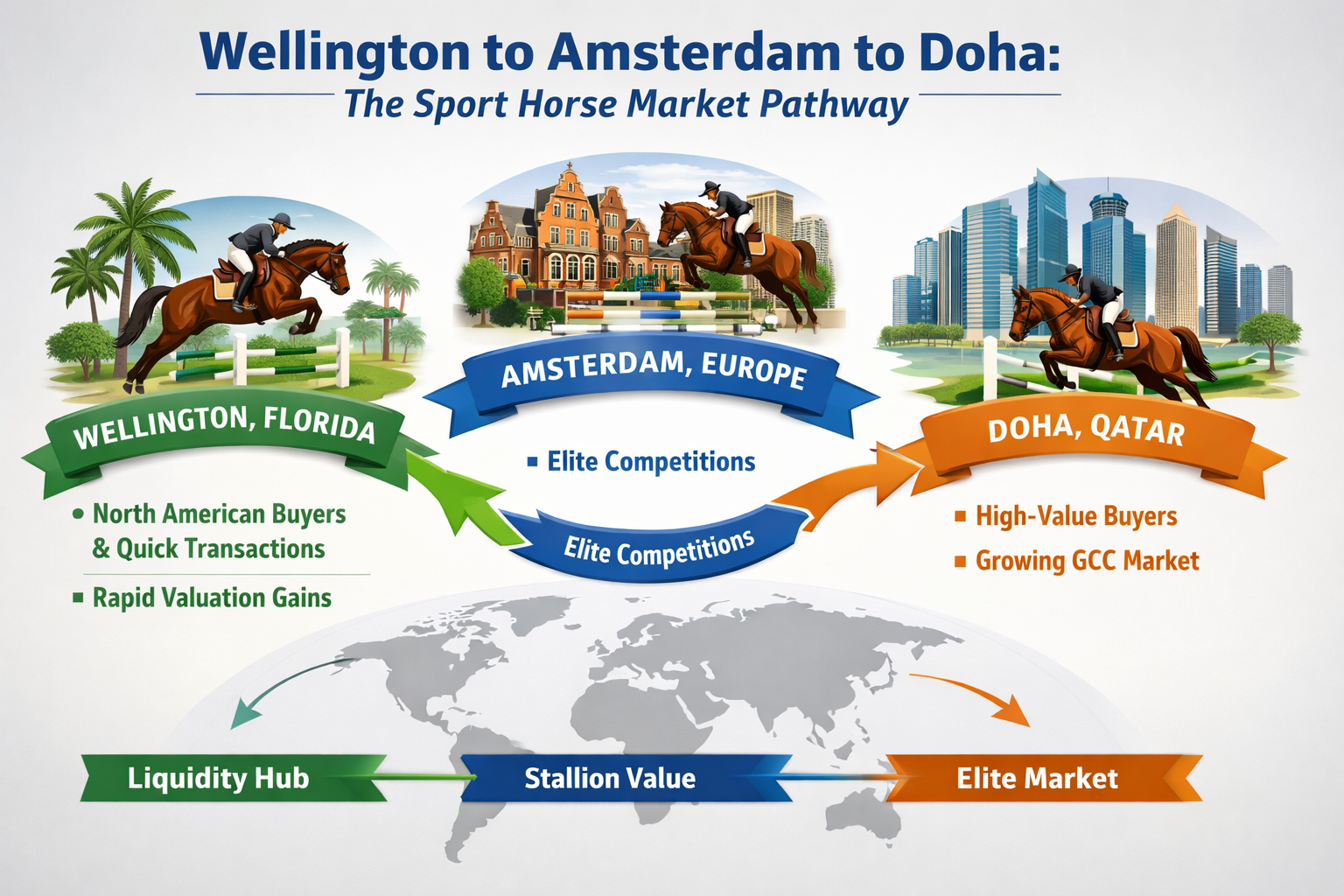
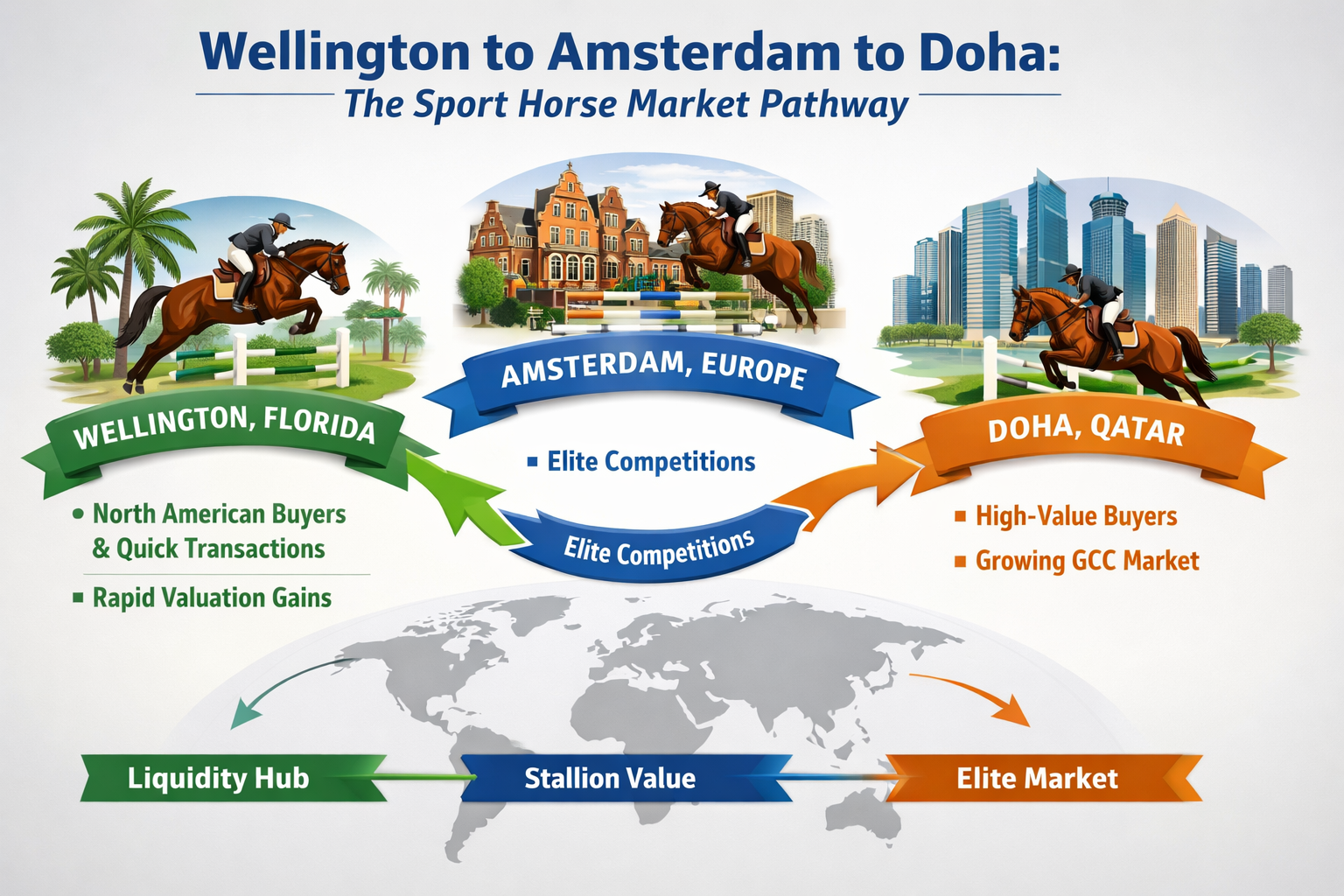
The sport horse market this week is being shaped by a fast-moving “Wellington to Amsterdam to Doha” corridor where results are turning into price signals almost overnight. Florida remains the liquidity hub: it is where North American buyers can watch, vet, and transact quickly, and where proven horses can translate a strong week into a meaningful valuation step-up. Meanwhile, Europe’s indoor circuit is reinforcing breeding and stallion value narratives, and Doha continues to prove that the Middle East is not just a show destination, but a serious end-market for high-value European talent.
The key theme is a widening spread between “immediate-impact” horses and developmental stock. Buyers and investors are showing a clear willingness to pay for certainty: horses that can step straight into CSI5* (or top CDI exposure) and perform under pressure are trading in a different lane to young or unproven horses, even when the underlying quality is there. This is the decoupling we are watching closely: proof and eligibility are being priced at a premium, while potential is still negotiable.
Discipline highlights
Showjumping: indoor proof, Middle East demand, and genetics in focus
Jumping Amsterdam delivered exactly the kind of signal the market responds to: a high-profile indoor win, in a pressure environment, with pedigree and performance aligning. Frank Schuttert and Isis took the CSI5*-W 1.60m Grand Prix in Amsterdam, reinforcing the commercial power of horses that can win at this level indoors.
Willem Greve and Grandorado TN N.O.P. also posted top-level results in Amsterdam, adding weight to the continued strength of Dutch production and Dutch-bred pipelines in the global buyer story.
In Doha, the commercial subtext is just as important as the sport. Scott Brash’s Grand Prix win on Hello Mango underscores the Middle East as a premium destination market where European-sourced horses can be acquired and campaigned at the very top level.
When Doha results land, they travel quickly into buyer conversations, because they validate that a horse is not just “good,” but globally deployable.
On the breeding and stallion side, the industry has been hit by two meaningful losses. Beerbaum Stables confirmed the passing of Olympic partner Goldfever at 35.
Zangersheide also announced the tragic loss of D’Aganix 2000 Z after an accident in Leipzig
Beyond emotion, these moments tend to tighten supply and accelerate demand around closely related lines and proven “performance genetics” narratives, especially when the market already feels scarcity at the very top.
Dressage: Wellington performance equals commercial lift
Wellington’s CDI results continue to act like a spotlight for value. Susan Pape’s wins at CDI5* Wellington, including a 5* freestyle victory with an 81%+ score, are exactly the kind of performance confirmation that changes how owners, syndicates, and buyers talk about a horse’s profile and future pathway.
Christian Simonson and Indian Rock have also strengthened a broader trend: young US-based riders with serious results are becoming commercially magnetic. Simonson secured his 2026 World Cup Final ticket through the Wellington CDI-W arc, which increases both rider-market pull and the perceived value of horses that can deliver those outcomes.
We are also seeing a robust “second-career” market. Eurodressage reported the sale of Nadine Capellmann’s Waitoni to Mexico, a signal that Grand Prix horses transitioning into new programs (often U25, junior pipeline, or ambitious private riders) remain highly liquid when the training and reliability are there.
Cerano Gold continuing with a British junior rider is another example of the same demand profile: proven experience repackaged into a development pathway.
Eventing: proven mileage keeps winning the capital allocation battle
While “future potential” is always compelling, North American buying patterns keep reinforcing one thing: five-star experience is a shortcut to outcomes. The sale of Santos Z to the US (announced by Horse & Hound) fits that same thesis: established top-level mileage is a premium asset because it reduces time risk and competitive uncertainty.
Auctions and sales: liquidity is selective, but very real
On the auction front, the DSP Stallion Days in Munich delivered clear signals about what buyers are willing to underwrite. The DSP auction platform shows a Heartbreaker x Diarado stallion as a 265,000 euro result, a reminder that the market will still pay aggressively when the package aligns with modern commercial demand.
Dutch reporting also highlights the pricing spread across the same event: one Feliciano champion moving to the Netherlands for 57,000 euro, while a separate top result hit 265,000 euro.
That gap is the decoupling in micro form: not every “approved” horse gets priced as a headline asset.
Breeding demand remains steady even outside peak season. Zangersheide 365’s “The Broodmares” collection saw Capucine de Jolie Z (Casall x Calato), in foal to Ermitage Kalone, top the sale at 32,000 euro, sold to a Brazilian buyer per Horses.nl. That is a useful reminder that premium genetics retain liquidity even when broader sentiment gets cautious.
And do not ignore the pony market. Eurodressage’s feature on the German Riding Pony mare Daria LGD (sold within 10 days) is consistent with what we see privately: premium ponies are often among the fastest-moving assets in the entire ecosystem because demand is deep and time-sensitive for families and junior pipelines.
Macro and regulatory context: keep-cost inflation and welfare governance
Two pressures matter right now.
First, forage and keep-cost inflation. UK industry voices and media are again warning owners to plan ahead as hay availability and pricing remain challenging. If this persists, we typically see owners rationalize stock: fewer “nice-to-have” horses, more capital concentrated in the best horses that justify their costs.
Second, welfare standards are moving from “soft expectations” to increasingly formal governance. In Canada, a draft update to the Equine Code of Practice has been released for public comment with a defined consultation window.
At the same time, equitation science and welfare research continues to shape reputational risk. Recent coverage highlights findings that younger and less experienced riders were more likely to show punitive responses after non-completion events, reinforcing why modern buyers and institutions increasingly value transparent, welfare-aligned training environments.
Bridl insight: what we would do this week
We are clearly in an aggressive pre-season acquisition phase. Buyers are not waiting for the outdoor spring circuit to finalize rosters, especially in North America and in export-forward markets like Mexico.
For sellers: if you have a horse that can realistically step into 1.45m+ showjumping work, or a Small Tour-to-Grand Prix dressage horse with reliable training and showability, this is a strong window to act while Wellington attention is at its peak and buyers are in “decision mode.” The market is rewarding readiness.
For investors: follow the liquidity signals, not the hype. The DSP results show a market that is still paying up, but only for the most obvious commercial profiles. Watch modern, rideable sire lines that produce horses buyers believe they can sell again quickly, and anchor your risk management around sound production systems and welfare transparency, because reputational risk is increasingly pricing into value.