

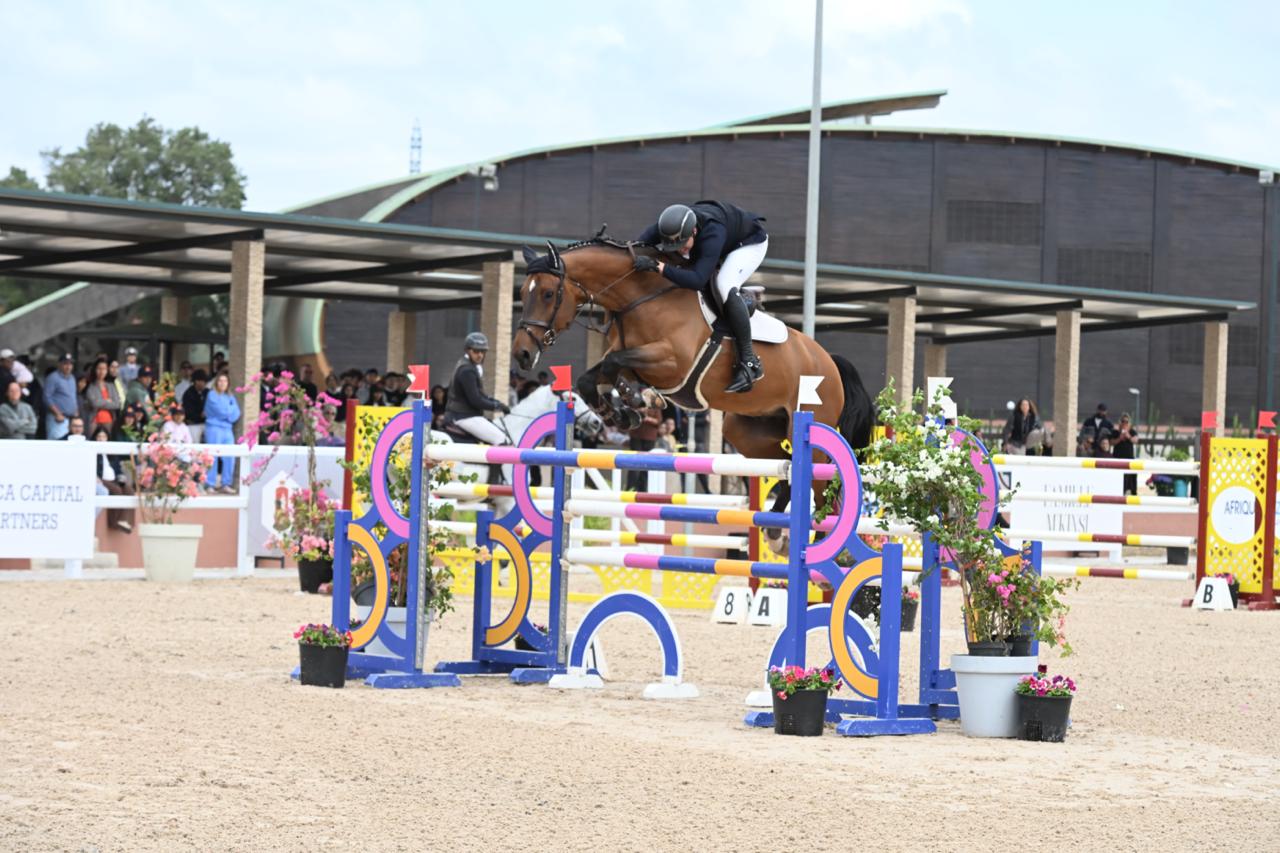
Some sales become more meaningful with time.
At Bridl, the moment a horse is sold is important, of course. It is the result of scouting, conversations, videos, trials, negotiations, vettings, logistics, and trust. But the part that matters most often comes later. It is the message after the horse has arrived. The first show. The first result. The first moment where the buyer says, without needing to say too much, that the match was right.
Mercurius is one of those stories.
Sold by Bridl to a private client in Morocco in July 2025, Mercurius was always a horse with serious quality. Tall, scopey, rideable, and competitive, he had the profile of a horse who could continue developing into a valuable international partner. By Ibolensky out of a Dulf van den Bisschop mare, he had the breeding, frame, and athletic quality that made him commercially interesting from the beginning.
But the reason this story matters now is not only because Mercurius sold.
It is because he has continued to prove himself.
Most recently, Mercurius placed second in a 1.50m Grand Prix in Morocco, an update that says far more than a simple result line. At 1.50m, a horse is no longer just “nice.” He is being tested. The fences are bigger, the margins are smaller, and the rider-horse relationship needs to be honest. At that level, quality alone is not enough. The horse needs scope, carefulness, rideability, confidence, stamina, and the right mental attitude to keep answering questions. The week later, he won the 1.50 GP!
That is why this result is such a strong Bridl story.
When we first look at a horse like Mercurius, we are not only asking, “Can he jump?” We are asking a much more important question: “Where does this horse belong?” A good horse can be placed badly. A talented horse can lose value in the wrong system. A horse with potential can stall if he goes to the wrong rider, the wrong program, or the wrong market.
Mercurius was never just a transaction. He was a placement.
Morocco is an increasingly interesting market for sport horses because it sits at the intersection of ambition, international sport, and developing infrastructure. The country has a serious equestrian culture, strong private buyers, and an increasingly visible showjumping circuit. The Morocco Royal Tour, in particular, has become a key reference point for international sport in the region, and its continued upgrades show that Morocco is not simply participating in the sport horse economy, it is investing in it.
That matters when we talk about a horse like Mercurius.
A horse capable of jumping and winning at 1.50m is not only valuable because of his current result. He becomes valuable because of where that result can take him. In an ambitious market, a horse like this can help raise a rider’s profile, build confidence in a program, and become a highly visible sport and commercial asset.
This is one of the shifts we see more and more in the global sport horse market.
For a long time, the most obvious buyer pathways were concentrated in Western Europe, North America, and a few established international hubs. But today, high-quality horses are moving into a much broader ecosystem. Morocco, Mexico, India, the Middle East, South America, and parts of Africa are not just “emerging markets” in a vague business sense. They are real destinations with riders, owners, investment, ambition, and increasing demand for quality European horses.
The challenge is that international demand does not automatically create good sales.
The more global the market becomes, the more important interpretation becomes. A buyer in Morocco may not need the same horse as a buyer in Wellington. A rider trying to build toward 1.50m classes may not need the same profile as an amateur looking for a safe 1.25m schoolmaster. A horse that is perfect in one country or system may not be the right choice in another.
That is where Bridl’s role becomes important.
We are not trying to move horses randomly around the world. We are trying to understand where each horse has the best chance of succeeding. With Mercurius, the match was about seeing not only what he had done, but what he could become in the right hands. His sale to Morocco was not just a geographical move. It was a strategic placement into a market and program where his quality could continue to be developed and recognized.
The 1.50m Grand Prix result validates that.
It shows that the horse was not overpromised. It shows that the buyer did not just receive a beautiful sales video. It shows that the horse could go into a new country, a new rider relationship, a new routine, a new competition system, and still continue to perform.
That is what we care about most.
Because in horse sales, there is always a gap between potential and proof. A horse may have scope. A horse may have breeding. A horse may have a beautiful jump. But until that horse continues to deliver after the sale, the story is not complete.
Mercurius gives us the complete story.
He represents the type of horse that is becoming increasingly sought after in the current market: tall enough, talented enough, competitive enough, but also rideable enough to keep building with his rider. The demand for this type of horse is strong because the supply is not unlimited. Horses that can genuinely operate around 1.45m and 1.50m while remaining manageable and useful for ambitious riders are difficult to find. They are not the same as raw scope horses. They are not simply “big jumpers.” They are horses who can convert ability into results.
That distinction matters.
The sport horse market often speaks in simple numbers: age, height, level, price. But real value is more complex. Value is the relationship between quality, usability, timing, market demand, and the probability that the horse will continue to succeed after purchase.
Mercurius had that value.
And now, with a 1.50m Grand Prix result in Morocco, that value is visible.
For Bridl, this is exactly why we follow the horses after they leave us. It is not enough to say a horse has sold. The stronger story is what happens next. Did the rider feel confident? Did the horse adapt? Did the results come? Did the partnership grow? Did the horse become what we believed he could become?
With Mercurius, the answer is yes.
And that is why this catch-up matters.
It is a reminder that good sourcing is not only about finding a horse. It is about understanding the future that horse can step into. It is about recognizing which markets are growing, which riders need what type of partner, and which horses have the mental and physical quality to keep developing after the deal is done.
Mercurius is not just a horse Bridl sold to Morocco.
He is a horse who is now proving himself in serious sport, in a market that continues to grow, with a result that makes the original match look even stronger.
That is the best kind of update.
Because a good sale is signed once.
A good match keeps proving itself.