

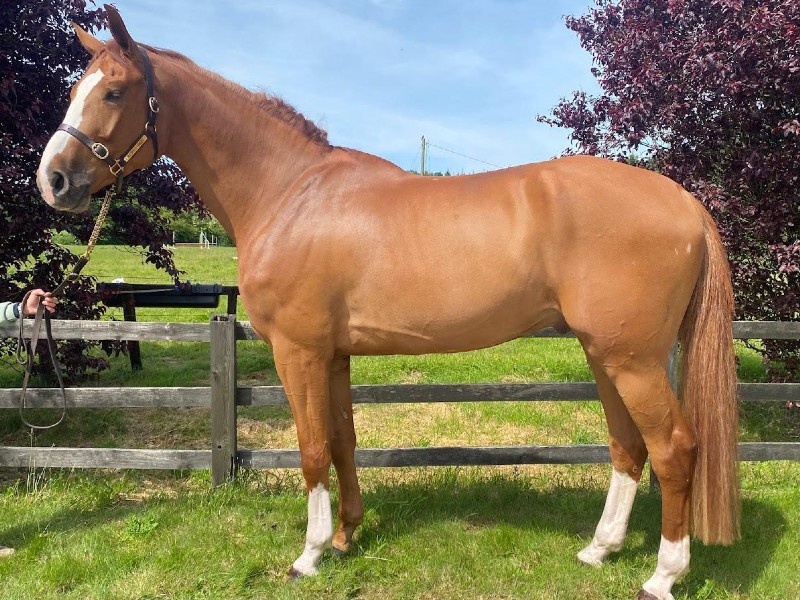
With young horses, the sale is only the beginning.
Flash is a perfect example of that.
Sold by Bridl to the United States in January, Flash has already started to show exactly why the right placement matters. His recent second-place finish in a 1.30m Young Horse class at Thunderbird is more than a good result. It is a sign that the horse has landed in a system where his potential is being protected, produced, and converted into performance.
Young horse sales are different from finished horse sales.
When a buyer purchases a seasoned schoolmaster, they are often buying experience. When they purchase a high-level Grand Prix horse, they are buying proof. But when they purchase a young horse, they are buying a trajectory.
That makes the match more delicate.
A young horse can have talent and still fail to develop correctly. He can have scope but lose confidence. He can be careful but become worried. He can have all the ingredients and still need the right rider, timing, and program to become valuable.
This is why Flash’s result matters.
A 1.30m Young Horse class is not just about jumping the fences. It is about education. The horse needs to stay rideable, confident, careful, and mentally available. A good result at that stage tells us that the horse is not only talented, but developing in the right direction.
For Bridl, this is one of the most important parts of young horse scouting.
We are not only asking, “Is this horse impressive today?” We are asking, “Can this horse keep improving?” “Does he have the brain to handle pressure?” “Will he suit the buyer’s system?” “Is this a horse who can gain value if produced correctly?”
Flash’s early success in the U.S. suggests that the answer was yes.
The U.S. market is especially interesting for young horses because it offers a strong commercial pathway. A horse with quality, rideability, and a good brain can develop into a jumper, equitation prospect, or even crossover candidate depending on his style. The buyer pool is deep, the competition system is structured, and the market has serious economic weight.
That does not mean every young European horse belongs in the U.S.
It means the right ones can do very well there.
Flash’s result is a reminder that international placement is not only about destination. It is about development. A young horse needs a buyer and rider who understand what he is now and what he can become later. He needs a program that builds confidence, not just height. He needs time to mature without being rushed.
When that happens, the horse’s value can grow.
This is the investment logic behind good young horse sourcing. The buyer is not simply buying a horse for today. They are buying the possibility that the horse becomes more competitive, more educated, more visible, and more valuable over time.
Flash’s second-place result at Thunderbird is exactly the kind of early signal you want to see.
It says the horse is adapting.
It says the placement makes sense.
It says the story is moving in the right direction.
For Bridl, that is the real win.
Because when a young horse leaves Europe and starts producing results in North America, it confirms that the scouting was not only based on talent. It was based on suitability, timing, and the right reading of the market.
Flash is still writing his story.
But this is a very good first chapter.